

Selling an Idaho Home During a Health Crisis: What You Actually Need to Know
A serious illness does not pause the house. The mortgage still bills, the utilities keep running, and if the property sits vacant for more than a few months, Ada County and Canyon County code enforcement start sending notices. If you or someone you care for is in that situation, the question is usually not whether to sell, but who can legally do it and what it costs to move fast.
The answer depends on two things: whether there is a valid power of attorney in place, and whether Medicaid is paying for any of the care.
When you can still make the sale yourself
If you are able to sign documents, even from a hospital bed or assisted living facility in Boise or Meridian, Idaho law does not require anything unusual. You can accept a cash offer, sign the purchase and sale agreement, and authorize closing with a title company by remote online notarization under Idaho Code 51-114A. St. Al’s, St. Luke’s, and most long-term care facilities in the Treasure Valley have discharge planners who can point you to mobile notaries if a standard RON session is not practical.
A cash sale is faster here because there is no lender timeline. A conventional sale with a buyer getting a mortgage runs 30 to 45 days minimum after the offer is accepted, and it typically requires you to make the house available for showings, inspection, and appraisal visits. When you are not at the house, each of those is a logistical problem. A direct cash close skips all of them.
When someone else has to handle it: power of attorney vs. conservatorship in Idaho
If the owner cannot manage the transaction, the legal path forward splits depending on whether they set up documents before the crisis.
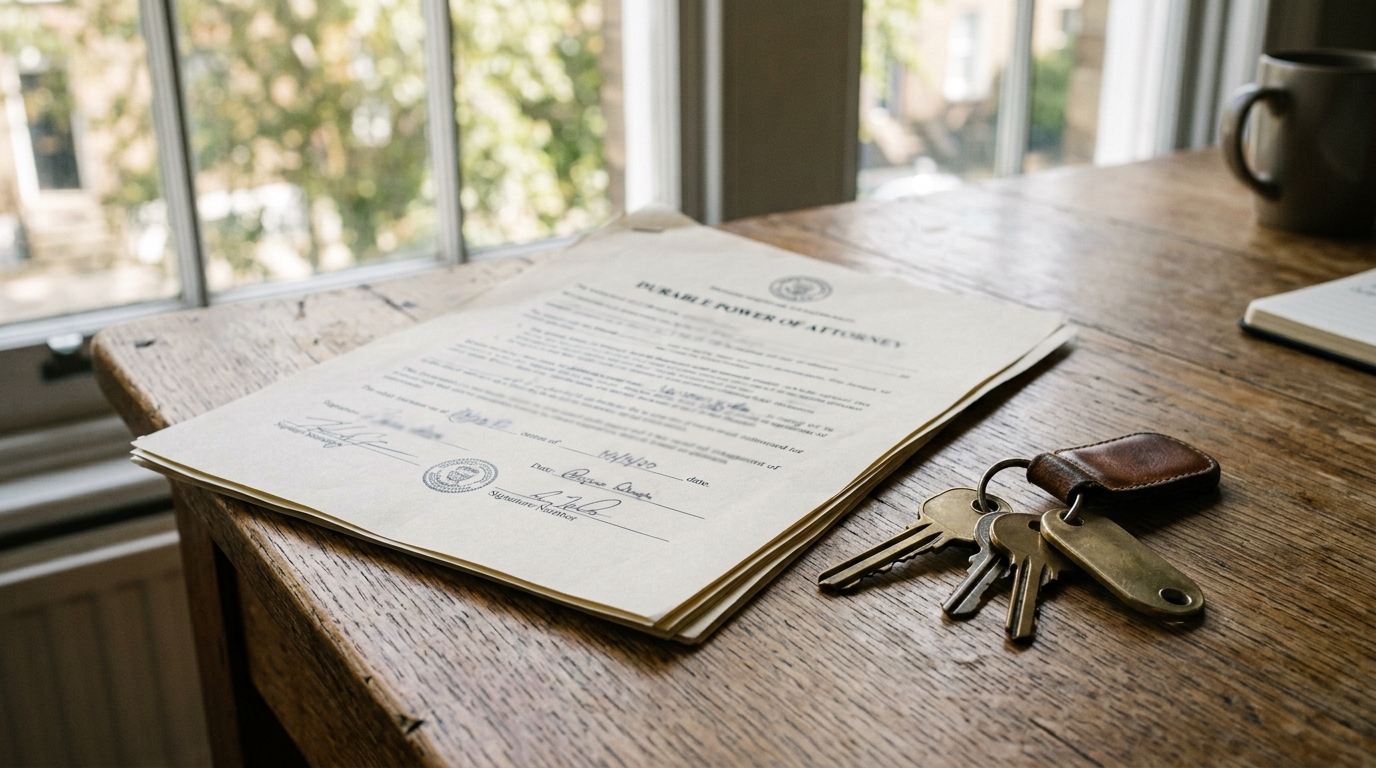
Durable power of attorney with real property powers. Idaho’s Uniform Power of Attorney Act, Title 15 Chapter 12 of the Idaho Code, allows a durable POA to remain in force even when the principal is incapacitated. The keyword is durable, spelled out in the document itself. If the POA expressly grants real property powers, the designated agent can sign the listing agreement, accept offers, and close the sale without any court involvement. The agent will need to record the POA in the county recorder’s office before closing. This is by far the fastest path: a properly drafted durable POA gets out of the way rather than creating friction.
Conservatorship when there is no POA. If no durable POA exists and the owner cannot sign documents, a family member or other interested party must petition the district court in the relevant Idaho county under IC Title 15, Chapter 5. The court appoints a conservator to manage property on the owner’s behalf. To sell real property, the conservator then needs a separate court authorization. The whole process typically takes 60 to 90 days at minimum, and that is with straightforward facts and no contested parties. A cash buyer can hold an accepted price for that window if there is a signed option or letter of intent in place. An open market listing cannot.
The Medicaid question
Idaho’s Medicaid Estate Recovery Program is authorized by Idaho Code 56-218. The state can recover long-term care costs from the estate of a recipient who received Medicaid benefits at age 55 or older. This is the thing most people are actually worried about when they search for guidance on selling an Idaho home during a health crisis.
A few things worth understanding clearly, because they affect how you time a sale:
While the owner lives in the house, it is exempt. Federal Medicaid law (42 USC 1396p) excludes the primary home from the asset test while the owner or their spouse lives there. If someone is receiving in-home care through Idaho’s home and community-based services program and is still living in their Boise or Nampa house, the property does not count against their Medicaid eligibility.
Once the home is vacant, things change. If both the owner and their spouse have moved to a care facility, the home is no longer exempt from the asset calculation. Idaho Department of Health and Welfare can place a lien on the property to secure future recovery. Selling before a lien is filed is often cleaner, because the sale proceeds go directly to the seller and the Medicaid obligation is handled separately at closing if required.
A fair market sale does not trigger the lookback. The federal 5-year Medicaid lookback, under 42 USC 1396p(c), penalizes asset transfers made below fair market value within 60 months of applying for long-term care Medicaid. A sale at a price a buyer is willing to pay, documented with a signed contract, is a fair market transaction. It converts the house to cash, which then becomes a countable asset. That cash may need to be spent down on qualifying care costs before Medicaid eligibility resumes, but the sale itself is not a disqualifying transfer. Giving the property away, or selling it far below market to a relative, is a different matter entirely.
The capital gains exclusion has a time component. Federal law allows you to exclude $250,000 of gain ($500,000 for a married couple) if you owned and lived in the home for 2 of the last 5 years. Two years in a care facility puts you near the edge of that window. Idaho taxes capital gains as ordinary income at a flat 5.8% state rate. Selling before the 2-of-5 window closes preserves the federal exclusion and avoids Idaho state tax on a potentially larger gain.
None of this is legal advice. Medicaid rules at the intersection of state and federal law are complicated enough that you should run the specifics past an Idaho elder law attorney before closing. Idaho Department of Health and Welfare handles Medicaid determinations and can be reached at 1-877-456-1233.
What a cash sale actually changes in this situation
The practical difference between a traditional listing and a direct cash sale is mostly about who has to do things and how long it takes.
A traditional listing in Boise or the Treasure Valley in 2026 typically runs 30 to 60 days on market before an accepted offer, then 30 to 45 days to close. That is 60 to 105 days during which the house needs to look ready for buyers, pass inspection, and possibly get repaired before an appraisal. If no one is living in the house and managing it, all of that falls on whoever holds the power of attorney or is acting as conservator.
A cash sale compresses that to 7 to 14 days after the offer is accepted. There are no repair requirements, no lender appraisal, no showings to coordinate. If the property needs to be sold fast to fund a care facility deposit or stop a carrying-cost bleed, that timeline matters in concrete terms.

What you keep vs. what you give up
Cash offers net less than a clean retail sale at top market value. On a $375,000 Boise-area house, here is roughly what the two paths cost:
| Item | Traditional listing | Direct cash sale |
|---|---|---|
| Agent commissions | $18,750 to $22,500 | $0 |
| Closing costs (seller-paid) | $3,000 to $5,000 | $0 (we cover) |
| Repairs before listing | $5,000 to $20,000 or more | $0 (any condition) |
| Carrying costs while it sits | $2,000 to $3,500 per month | Eliminated at close |
| Offer price | Closer to market value | Below market value |
| Total timeline | 60 to 105 days | 7 to 14 days |
The gap between those two net numbers narrows when you add up carrying costs on a property no one is maintaining, the repairs a vacant house tends to accumulate, and the effort a POA agent or conservator spends coordinating a traditional listing during an already difficult period.
Who should not sell for cash here
A direct cash sale is not always the right answer.
- If the property is in good condition near Boise or Meridian with strong buyer demand and you can carry it for 90 days without financial strain, a retail listing will likely net more
- If the health situation is temporary and the intent is to return home, selling now closes that option permanently. There is no undoing a close
- If you need a specific net number to fund care costs and a cash offer does not reach it, the math does not work. Know your number before accepting any offer
- If the home is an investment property with tenants paying monthly rent, the carrying-cost math looks different and the urgency is lower
Common Questions
Can a power of attorney sell a house in Idaho without going to court?
Yes, if the POA expressly includes real property powers and is durable, meaning it stays in force during incapacity. Under Idaho Code Title 15, Chapter 12, a durable POA with real property authority allows the agent to sign all documents needed to close a sale. The document must be notarized and will need to be recorded with the county recorder before the title company will close.
Does selling my house affect my Medicaid in Idaho?
A sale at fair market value converts a home into cash, which then counts as a Medicaid asset. If the proceeds push your liquid assets above Idaho’s Medicaid eligibility threshold, your eligibility pauses until those assets are spent down on qualifying care costs. The sale itself is not a disqualifying transfer, but the resulting cash is a countable asset. Talk to an Idaho elder law attorney about timing, and contact Idaho DHFW directly at 1-877-456-1233 for your specific situation.
How long does conservatorship take in Idaho if there is no power of attorney?
Getting a conservatorship established in Idaho district court typically takes 60 to 90 days in straightforward cases, and that is before any court authorization to sell real property is sought. If the situation is urgent, an emergency temporary conservatorship can sometimes be ordered faster. An Idaho elder law or probate attorney can advise on the specific county court schedule and current processing times.
Does Idaho have a Medicaid estate recovery program?
Yes. Idaho Code 56-218 authorizes the state to recover Medicaid long-term care costs from the estate of a recipient who was 55 or older when they received benefits. The state can file a lien against real property. This is why some families sell before a lien attaches, but the right decision depends on the individual situation. Consult an Idaho attorney before making that call.
If you need to move quickly
If you are managing a family member’s property in Ada County or Canyon County while they are in care, or if you are the one dealing with a serious diagnosis and need to know your options, call us at (208) 418-0702. We give a cash offer within 24 hours, cover all closing costs, and can close in 7 days or hold for 60 days while a conservatorship processes. There is no obligation and no listing required. See our get a cash offer page for details on how the process works, or read about the behind-on-payments scenario if financial pressures are compounding at the same time. If you are in the Treasure Valley, the Nampa and Meridian pages have local market context.