

Selling a House After Your Spouse Dies in Idaho: Title Transfer, the Two-Year Tax Window, and When Speed Matters
Your spouse just died and the house is still in both names. The path forward depends on three words in the deed. If those words give you right of survivorship, you can likely sell without going through probate at all. Here is what those words mean, what the Idaho-specific tax situation looks like, and when a fast cash close is actually the right call.
How Idaho handles title when a spouse dies
Idaho gives married couples three main ways to hold real property, and each one produces a different path to sale.
Community property with right of survivorship (IC 15-6-401). If the deed uses this language, your spouse’s half transfers to you automatically at the moment of death. No probate required. You record an affidavit of survivorship and a certified death certificate with the Ada or Canyon County recorder, and the title is yours to sell. Idaho added this ownership type to its statutes in 2008, so it appears on deeds written or updated since then. Older deeds may not have this language.
Joint tenancy with right of survivorship. Same practical result. If the deed says “joint tenants with right of survivorship,” the property passes to you automatically. Idaho Code 55-104 permits this ownership type when it is expressly declared in the deed. Record the affidavit and death certificate, and you can proceed to sale.
Community property or tenancy in common without right of survivorship. Many older Idaho deeds simply say “husband and wife” or “as community property” without survivorship language. Under IC 55-104, the default when ownership is not specified is tenancy in common, meaning your spouse’s half passes through their estate. That requires some form of probate or estate administration before you can sell.
One thing Idaho does not have: a Transfer on Death deed. Several states allow a deed that pre-designates a beneficiary and transfers property at death without probate. Idaho has no such statute. The options above are the only paths.
Filing the affidavit of survivorship
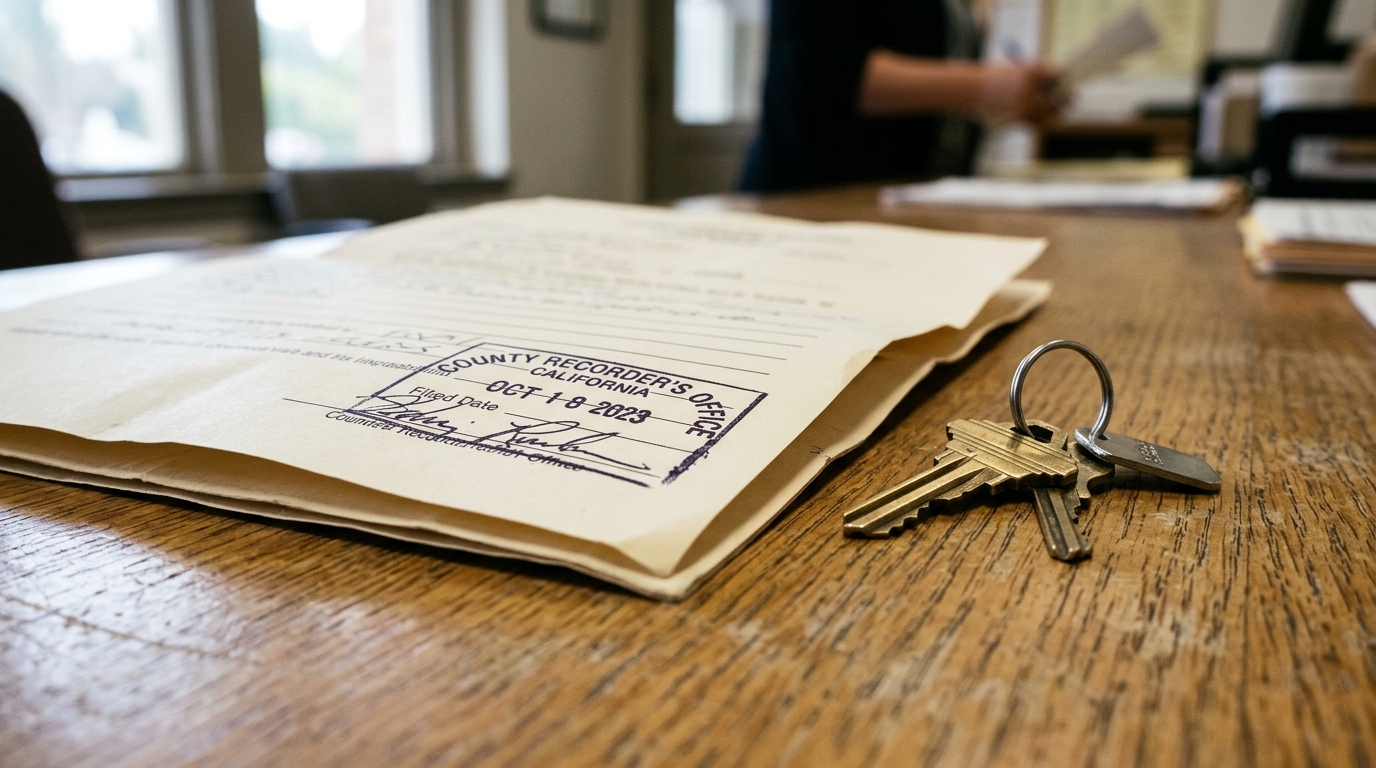
If the deed has right-of-survivorship language, the affidavit is a one-to-two page document stating the title held, identifying the deceased, and declaring you as the surviving owner. Attach a certified copy of the death certificate and take both to the county recorder’s office.
In Ada County (Boise) and Canyon County (Nampa, Caldwell), recording fees run approximately $10 for the first page and $3 for each additional page under Idaho Code 31-3205. Most county recorder offices process these same-day or within a few business days. You do not need an attorney to file one. Idaho Legal Aid Services has forms available for qualifying low-income Idahoans.
Once recorded, the title is in your name alone. You can list the property, accept a cash offer, or refinance without anyone else’s signature.
When you do need probate: the surviving spouse shortcut
If the deed does not have right-of-survivorship language and there is no living trust covering the property, your spouse’s interest passes through their estate. That means probate.
Idaho does offer a shortened process for surviving spouses. Under IC 15-3-1205, if you are the sole devisee or beneficiary of the estate, you can file a verified petition with the district court and the court can issue a decree transferring the property to you without full probate administration. You do not need to appear in person; the statute allows appearance by telephone or affidavit. This is meaningfully faster than full probate, though it still involves court filings, attorney involvement, and typically 4 to 8 weeks.
One trade-off to weigh: under IC 15-3-1205, you take on full personal liability for debts of the estate in exchange for skipping formal administration. If there are significant creditor claims, that exchange warrants careful thought before you elect this path.
The capital gains question: why Idaho community property works in your favor
This is the part most surviving spouses do not know going in, and it can mean the difference between a significant capital gains bill and owing nothing.
Federal tax law under IRC 1014(b)(6) gives community property a specific advantage when a spouse dies: both halves of the community property receive a new cost basis equal to fair market value at the date of death. Not just the deceased spouse’s half. Both halves.
In states that use common-law title, only the deceased spouse’s half gets stepped up to current value. The surviving spouse keeps their original cost basis on their half, which creates a taxable gain on that portion when they sell. Idaho’s community property status eliminates that problem for property held as community property during the marriage.
A worked example with Nampa numbers: you and your spouse bought a home in 2001 for $145,000. It is now worth $415,000. In a common-law state, your basis after your spouse’s death would be $72,500 (your original half) plus $207,500 (the stepped-up half for your spouse), totaling $280,000. Gain on sale: $135,000. At Idaho’s 5.8% income tax rate on capital gains, that is $7,830 in state taxes before federal liability.
Because Idaho is a community property state, both halves of the $415,000 house step up to current value at death. Your new basis: $415,000. Gain on sale: zero. You owe nothing on the appreciation built up during the marriage.
This applies to property that was community property: generally, property acquired during the marriage from joint income or marital funds. Property one spouse owned before marriage, or received as a separate inheritance and kept separate, is handled differently. An Idaho CPA or attorney can confirm which category applies to your house.
The two-year window you should not miss
A second federal rule interacts with the stepped-up basis above: IRC 121(b)(2)(B), which governs the capital gains exclusion for a surviving spouse.
Normally, married couples can exclude up to $500,000 of capital gains on the sale of a primary residence if they have lived there 2 of the last 5 years. When your spouse dies, you can still use that $500,000 exclusion, but only if you sell within two years of the date of death. After that window, you file as single and the exclusion drops to $250,000.
On a house with significant post-death appreciation, the $250,000 difference in exclusion matters. At Idaho’s 5.8% capital gains rate, a $250,000 reduction in your exclusion adds $14,500 in Idaho income tax alone, on top of federal liability. This is sometimes called the widow’s tax trap, and it is a real cost if you delay past the two-year mark.
In practice, the combination of a full stepped-up basis at death and the $500,000 exclusion means many Idaho surviving spouses who sell within two years owe no capital gains at all. If the house appreciates significantly between the date of death and your sale date, the exclusion matters more. Either way, run this calculation before deciding whether to sell now or in three years. Consult an Idaho CPA or tax attorney for numbers specific to your situation.
Idaho has no estate tax and no Transfer on Death deed
Idaho repealed its state estate tax in 2004 when the federal credit it was tied to was eliminated. There is no Idaho estate tax at any estate size. Federal estate tax applies only above the current federal exemption threshold, which is well above what most Idaho homeowners hold. If the total estate is large, verify the current federal figure with an estate attorney.
Idaho also has no real estate transfer tax on the sale itself. For a full breakdown of what you actually pay at a closing in Idaho, see our post on Idaho closing costs and what replaces a transfer tax.
When selling quickly after a spouse’s death makes practical sense
The mechanics above tell you what you can do. Whether a fast cash sale is the right move depends on your specific situation.
A cash sale makes sense when the house carries costs you cannot sustain alone. Mortgage, property taxes, HOA dues, utilities, and maintenance do not pause. On a Boise or Meridian house with a $2,200 monthly mortgage and carrying costs, every month you hold it is $2,200 less in net proceeds. A 7 to 14 day cash close ends that math immediately.
It also makes sense when deferred maintenance was your spouse’s domain and the thought of contractor bids, inspections, and showings while you are grieving is not feasible. We buy in any condition. There are no repairs to manage and no one walking through the house on a Saturday morning.
The two-year capital gains window is itself a reason some surviving spouses act sooner rather than later. If you know you want to sell eventually, selling in year one while the $500,000 exclusion applies removes the tax timing question entirely.
For Treasure Valley properties, see our local pages for Nampa, Meridian, and Caldwell for context on cash offer timelines in your market.
Who should not sell for cash after a spouse’s death
A cash offer is not the right move in every situation.
If the house is in good condition, the estate is settled, and you have no financial pressure, a traditional listing will almost certainly net you more money. Cash buyers pay below retail because they absorb the risk of what they do not know about the house. In a Boise or Treasure Valley market with normal demand, a clean retail listing is worth the extra time if you can manage the process.
If title is not yet clear because the deed requires probate before it can transfer, a cash sale still has to wait. Even a motivated buyer cannot close on title you do not yet hold.
If there are other heirs whose interests must be resolved, or a dispute over whether property was community or separate, those questions need answers before any sale. A fast close does not shortcut a contested estate.
And if you are not sure whether you are within the two-year capital gains window, or whether the stepped-up basis fully covers your situation, get that confirmed by a CPA before committing to a price. Selling at a discount to close faster is a reasonable trade. Selling without understanding your tax position first can be a more expensive mistake.
Common Questions
Can I sell my house without probate after my spouse dies in Idaho?
Usually yes. If the deed says “community property with right of survivorship” (IC 15-6-401, available since 2008) or “joint tenants with right of survivorship” (created by deed declaration under IC 55-104), you file an affidavit of survivorship and a certified death certificate with the county recorder. Once recorded, title is yours and you can sell without probate. If the deed has neither, you will need probate or the surviving spouse summary procedure under IC 15-3-1205.
What is the widow’s tax trap in Idaho?
Federal law (IRC 121(b)(2)(B)) gives a surviving spouse two years from the date of death to sell the primary residence and still claim the $500,000 capital gains exclusion available to married filers. After that window, you file as single and the exclusion drops to $250,000. At Idaho’s 5.8% capital gains rate, a $250,000 reduction in your exclusion costs $14,500 in Idaho income tax alone. Idaho’s community property stepped-up basis often reduces the underlying gain to near zero, but the timing still matters if the house appreciates after your spouse’s death.
Does Idaho have an estate tax?
No. Idaho repealed its state estate tax in 2004. You will only owe estate tax if the total taxable estate exceeds the current federal exemption. Idaho has no separate state estate tax at any estate size.
How do I transfer title to my house after my spouse dies in Idaho?
If the deed has right-of-survivorship language, file an affidavit of survivorship and a certified death certificate with your county recorder. Ada County serves Boise; Canyon County serves Nampa and Caldwell. Recording fees are approximately $10 for the first page under IC 31-3205. After recording, the title is in your name alone and you can sell or refinance. If the deed does not have survivorship language, you will need the IC 15-3-1205 summary procedure or full probate before you can sell.
If you want a cash offer on your Idaho home within 24 hours, call us at (208) 540-8257 or request a cash offer here. We cover closing costs, buy in any condition, and you set the closing date.