
What a Boise Cash Offer Actually Nets You After the Costs You Do Not Pay
You have a cash offer on your Boise house and it looks like a discount off what you hoped to list for. Before you decide how you feel about that gap, run the other side of the math. The listing path in Boise carries costs that most sellers do not fully account for until closing day, and once those costs are on paper, the difference between a cash offer and a retail net is usually smaller than the headline numbers suggest.
What a Boise Seller Actually Pays to List
A traditional sale in Ada County has costs in two phases: out-of-pocket before the listing goes live, and deductions at closing. Both reduce what you walk away with.
Before the listing
Most houses need work before they photograph well and show well. A pre-listing inspection in Boise typically runs $350 to $500. If the report flags the roof, HVAC, or electrical panel, buyers will ask for repairs or a price credit. On a 1980s or 1990s Boise house in functional but dated condition, a realistic pre-listing refresh runs $4,000 to $12,000: touch-up paint, new light fixtures, a furnace service call, minor landscaping. Add staging at $1,500 to $3,500 for a house that is partially furnished or dated.
Carrying costs during the listing
Opendoor’s Idaho market data puts the average days from list to contract at about 49 days statewide. Ada County often runs faster in active price ranges, but add 30 to 45 days to close after the contract is signed. On a $450,000 Boise house with a $2,200 monthly mortgage payment, property taxes running roughly $2,500 to $3,500 per year on an Ada County primary residence (Idaho’s homeowner’s exemption reduces assessed value on primary homes, so your actual bill depends on your school district levy), and $150 in utilities and insurance, carrying costs run $2,500 to $2,700 per month. Over 75 days from list to close that is roughly $6,000 to $6,750 before a dime changes hands at closing.
Closing costs
Idaho has no real estate transfer tax. A 2006 law eliminated it and it has not returned. What sellers do pay at a traditional closing:
- Listing agent commission: 2.5 to 3 percent
- Buyer agent compensation: typically 2 to 2.5 percent. Since the NAR settlement took effect in August 2024, buyer agent compensation is no longer mandated through the MLS. In practice, offering it remains common in Ada County to attract buyer representation, but it is now negotiated separately.
- Owner’s title insurance policy: approximately 0.5 to 0.6 percent of the sale price in Idaho
- Title company escrow fee: $600 to $1,100
- Recording fees under Idaho Code 31-3205: $15 per page on the deed, typically $45 to $75 total
- Property tax proration: if you close mid-year, you credit the buyer for taxes accrued but not yet billed, often several months of taxes depending on the billing cycle
On a $450,000 sale at 5 percent total commission, that one line item is $22,500. Add the title and escrow stack and you are looking at $27,000 to $30,000 off the gross at closing, on top of whatever you spent pre-listing. For a full breakdown of what Idaho sellers pay at closing, see our post on Idaho closing costs and what you actually pay instead of transfer tax.
The Worked Example: A $450,000 Boise House
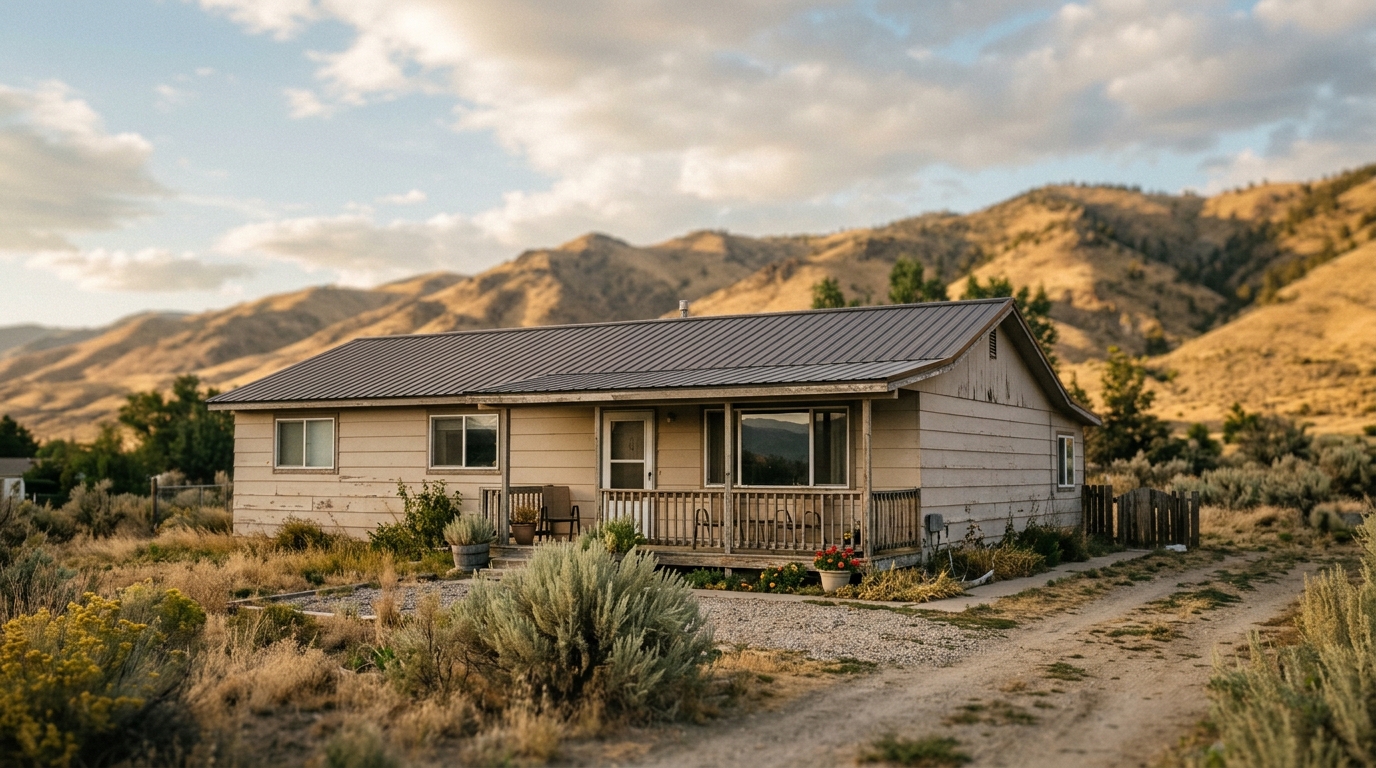
This is a three-bedroom, two-bath house built in the 1980s. Functional and dated. No deferred maintenance disasters. Not a fixer. Not turnkey. The kind of house that describes a meaningful portion of the Boise metro inventory in the $400,000 to $500,000 range.
| Traditional listing | Cost |
|---|---|
| Pre-listing repairs and refresh | $7,500 |
| Staging | $2,000 |
| Carrying costs, 75 days | $6,400 |
| Agent commissions (5%) | $22,500 |
| Title insurance and escrow | $5,200 |
| Proration and recording fees | $1,800 |
| Total deductions from gross | $45,400 |
| Gross sale price | $450,000 |
| Net before mortgage payoff | $404,600 |
| Cash sale (direct buyer) | Cost |
|---|---|
| Pre-sale repairs | $0 |
| Commissions | $0 |
| Seller closing costs | $0 (we cover them) |
| Carrying costs, 10 days | $867 |
| Total deductions from gross | $867 |
| Cash offer price | $372,000 |
| Net before mortgage payoff | $371,133 |
The gap between these two paths on this house: about $33,500. That is a real number. A cash offer at 82.7 percent of retail value does not mean losing $78,000. It means netting about $33,500 less than a clean retail sale, and that assumes the retail sale goes smoothly. If the inspection comes back with a roof or HVAC condition and triggers a renegotiation, or if the buyer’s financing falls through and the clock resets, the gap narrows further.

Why the Cash Offer Is Priced the Way It Is
A direct cash buyer purchases as-is and carries the house through renovation and resale. The offer reflects what the house is worth now in its current condition, minus what it will cost to bring it to retail-ready, minus a margin to make the transaction viable. On a house in average Boise condition, that math typically produces an offer in the 78 to 85 percent range of current market value, not after-repair value.
For a house that needs more significant work, the cost comes out of the offer rather than out of your net through inspection credits in a traditional sale. A roof replacement on a typical Boise single-story runs $12,000 to $18,000 as of 2026. A full HVAC system replacement runs $8,000 to $14,000. Both of those would appear in a traditional sale either as pre-listing costs you pay or as a post-inspection credit you give. In a cash sale they reduce the offer price instead, but you do not manage the work or the timeline.
The offer is not designed to take advantage of anyone. It is the arithmetic of a specific transaction where the buyer takes on condition risk and renovation risk in exchange for certainty on your side.
iBuyer Offers Are a Different Product
Opendoor operates in the Boise market and will generate a preliminary offer quickly. Their service is built for a specific seller type: a house in reasonably good condition within the price range their resale model supports. What to understand about their structure: Opendoor charges a service fee on top of their offer, and they conduct a secondary in-person assessment after the preliminary offer is made. That assessment frequently results in additional repair deductions that reduce the number below what was initially quoted. The headline offer and the number that closes can be different.
A local direct buyer does not charge a service fee. The offer is the offer. We cover your closing costs. There is no secondary walkthrough that revises the number after you have committed to the timeline.
When a Cash Sale Makes Less Sense
The cash path is not right for every Boise seller. It makes less sense in these situations:
- Your house is already updated and in strong demand. A house in Southeast Boise or the North End, recently renovated and priced correctly, can attract multiple offers within the first week of listing. In that scenario, a retail sale almost certainly nets more than a cash offer.
- You have no timeline pressure and no carrying cost. If the mortgage is paid off and you are not in a hurry, the roughly $33,500 premium from a retail sale is worth pursuing. The carrying cost equation changes when there is no monthly payment.
- You are in the upper price tier. Above $700,000 in the Boise metro, the direct cash buyer pool narrows. Offer discounts relative to retail can be wider in that range because renovation cost and resale risk both increase.
If your situation involves a lien, a partnership dispute, or a probate estate with multiple heirs, consult an Idaho attorney before accepting any offer. Those complications do not disappear at the signing table regardless of how the sale is structured.
How the Timeline Difference Affects the Real Net
The carrying cost figures in the table assume 75 days of holding time for a traditional sale. That is a reasonable average, not a guaranteed outcome. If buyer demand softens or interest rates stay elevated, time on market can stretch. Every additional 30 days adds $2,500 to $2,700 to the cost of the listing path on this house, which shifts the comparison. A 120-day listing cycle on a Nampa or Caldwell-adjacent property moves the numbers further toward the cash path.
The faster close also matters if you are in contract on a replacement property. A 7 to 14 day cash close means you are not managing two mortgages or a bridge loan. If your purchase falls through because your sale drags past a contingency deadline, that cost is hard to quantify but it is real. For sellers moving within the Treasure Valley, including those heading to Nampa, a firm close date has value that does not appear in the table.
Common Questions
Will I net more money listing with an agent in Boise?
On a house in good condition with no timeline urgency, usually yes, once all costs are counted honestly. On a dated or as-is house where the inspection will produce credits, pre-listing costs are significant, or you have carrying costs compounding over a longer market time, the gap narrows. The right answer depends on your specific house, not on a general rule. Running the actual cost table for your situation takes about 20 minutes and produces a real answer.
How do you calculate net proceeds from a cash home sale?
Start with the cash offer price. Subtract any outstanding mortgage balance. There are no commissions, no repairs, and no seller closing costs in a direct cash purchase with us. The number you are left with is what arrives in your account. Compare that against the retail path by subtracting commissions, pre-listing costs, carrying costs, and closing costs from the projected sale price. The table above shows one worked version of that math.
Does selling for cash change how I am taxed on the sale in Idaho?
No. A cash sale does not change whether you owe capital gains tax or Idaho state income tax on the proceeds. The Section 121 exclusion ($250,000 single, $500,000 married filing jointly for a primary residence) applies to cash sales the same as financed ones. One timing difference: a cash sale can close in a different calendar year than a traditional listing would, which may matter if you are near an exclusion threshold or managing other income. Ask a CPA if the timing is relevant to your situation.
What does “we cover closing costs” actually mean for an Idaho seller?
It means we pay the title company escrow fee, the owner’s title insurance policy, and the recording fees under Idaho Code 31-3205. You do not write a check at closing. The offer amount, minus your outstanding mortgage balance, is what arrives in your account. There is no service fee deducted afterward.
To run these numbers on your specific Boise house, call us at (208) 540-8257 or visit get-a-cash-offer for a no-obligation offer.